
Where Opportunity Cost Actually Comes From: The Workflow Friction Loop
Feb 14, 2026
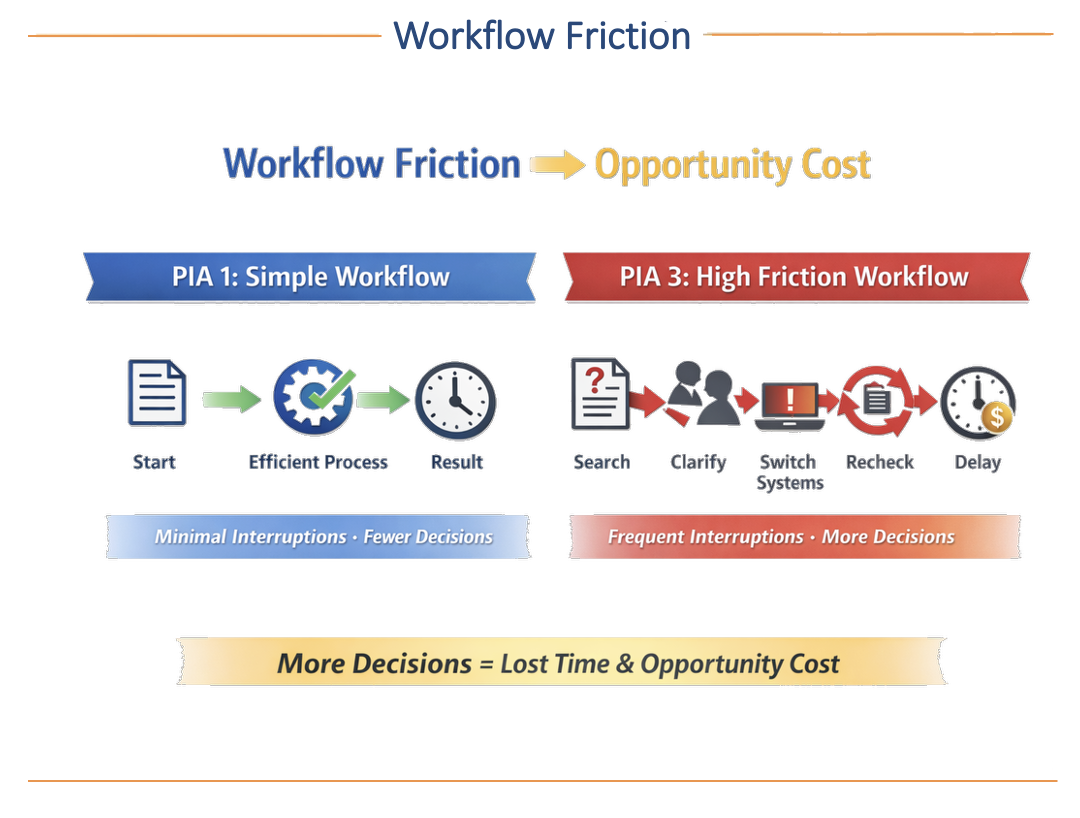
Most workflows don’t fail. They work.
But over time, they become harder to use.
Not because of one major issue—but because of small, repeated moments of friction.
What Is Workflow Friction?
Workflow friction is not always obvious.
It shows up in simple ways:
- searching for information
- clarifying next steps
- switching between systems
- rechecking details
Each moment feels minor, but each moment interrupts the flow of work.
The Pattern Behind Lost Time
When friction appears, something predictable happens.
It creates a loop:
Friction → Interruptions → Decisions → Time → Opportunity Cost
Step 1: Friction
Something isn’t clear.
Information isn’t where it should be.
The workflow isn’t seamless.
Step 2: Interruptions
Work pauses.
A question is asked.
A file is searched for.
A step is revisited.
Step 3: Decisions
Now someone has to decide:
- Where is this?
- What do I need?
- Who has it?
- What’s next?
Each interruption creates a decision.
Step 4: Time
Decisions take time.
Not just individually—but cumulatively.
Small delays begin to stack.
Step 5: Opportunity Cost
Time lost in these small moments becomes an opportunity cost
Not because of poor strategy. Because of how the workflow operates.
Why This Matters
Most organizations focus on:
- improving outcomes
- adding technology
- increasing capability
But they often overlook something more fundamental: how easy the workflow is to use.
The Role of the PIA Index™
This is where the PIA Index™ becomes practical.
It helps identify the level of friction in a workflow.
PIA 1 (Low Friction)
- clear steps
- minimal interruptions
- few decisions
Work flows naturally
PIA 3 (High Friction)
- repeated interruptions
- unclear pathways
- constant decisions
Work slows down
Most workflows don’t start as PIA 3.
They drift there over time.
Where This Shows Up
The workflow friction loop appears across everyday operations:
- referral coordination
- communication between providers
- implant system management
- dental lab workflows
- multi-system environments
The issue is rarely capability.
It’s the number of decisions required to complete a task.
A Better Way to Evaluate Workflows
Instead of asking: “Does this system work?”
Ask: “How many decisions does this system create?”
That question reveals:
- hidden friction
- unnecessary complexity
- avoidable delays
Breaking the Loop
The only way to break the workflow friction loop is to:
reduce decisions
This means:
- simplifying entry points
- centralizing information
- standardizing processes
- removing unnecessary steps
When decisions decrease:
- interruptions decrease
- workflows accelerate
- time is recovered
Final Thought
- Opportunity cost rarely comes from big failures. It comes from small, repeated interruptions.
- And those interruptions come from friction.
- Friction creates decisions.
- Decisions create time.
- Time becomes an opportunity cost.